


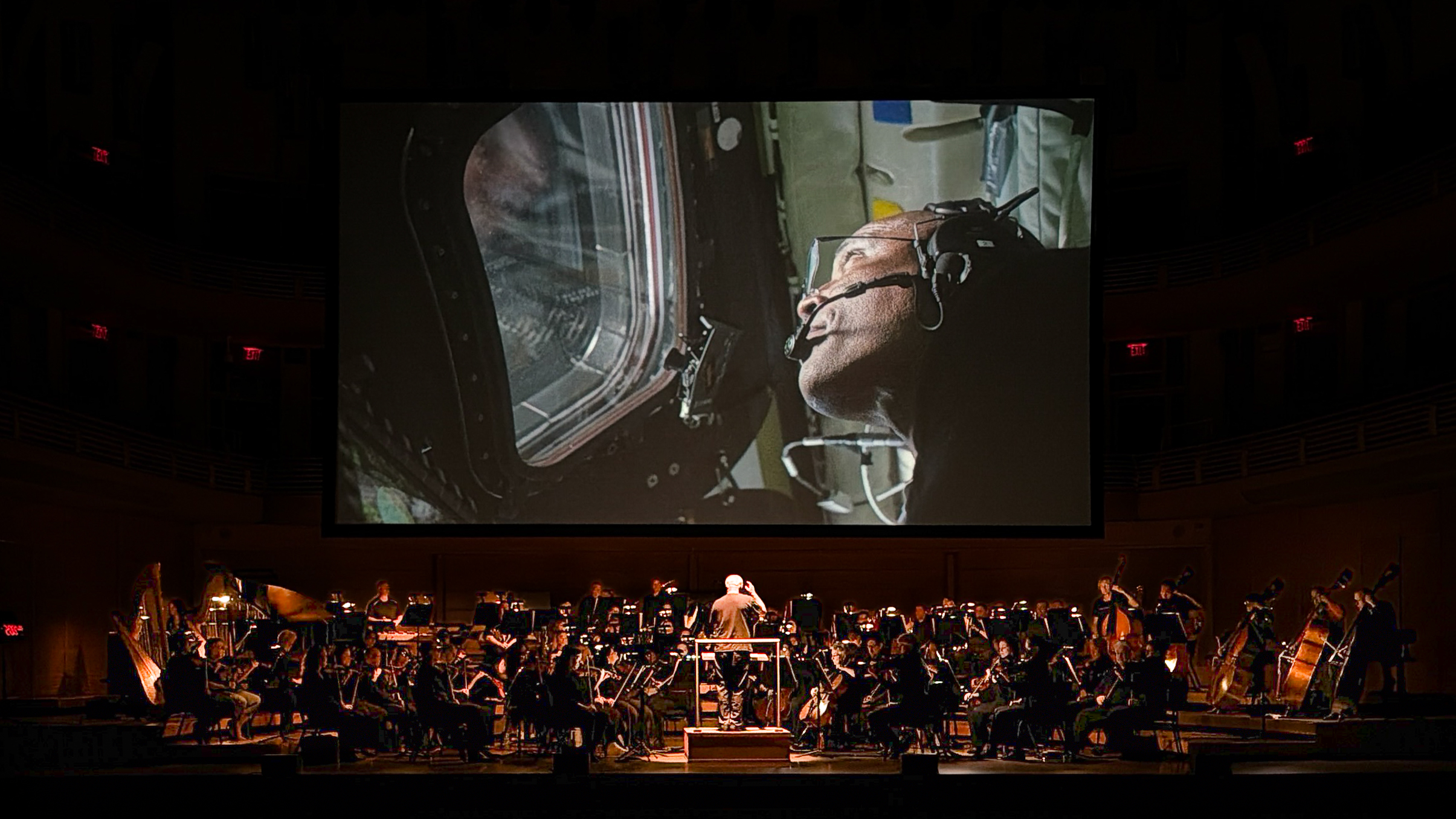
Don’t miss being part of this unforgettable film + live orchestra experience. Beyond Earth: A Celestial Odyssey comes to life on May 10th for the very first time, along with selections from Cosmic Cycles: A Space Symphony. Tickets are selling fast, so be sure to reserve your seats now. Click here for tickets.
Tracing humanity's journey beyond our home planet, Beyond Earth unfolds across three visual arcs—Apollo archival footage, stunning International Space Station sequences, and imaginative visions of future exploration inspired by Artemis II, Voyager, OSIRIS‑REx, and more.
Movement I. Ad Lunam recounts the Apollo missions using original footage and a gradual expansion of orchestral scale and energy. It opens in hushed reverence beneath a star-strewn sky. A solitary flame—our earliest source of light and warmth in the prehistoric night—flickers before transforming into the Saturn V rocket.
Layered entrances chart the arc from wonder to action, mirroring the mounting tension of launch, the vast silence of space, and the suspended grace of lunar orbit.
As Earth falls away and the Moon draws near, the orchestration thins to a translucent shimmer. Harp bisbigliando becomes the focal color, surrounded by sustained, floating sonorities that suggest both weightlessness and profound isolation. It casts a glassy, spherical glow across the texture, as if illuminating the silent void below.
After the lunar module lands, the harmony opens into restrained triumph—radiant yet contained—allowing reflection to temper celebration.
Inspired by a visual narrative created by NASA’s Cathy Ching, Sarah Gordon and Lindsey Tober, Ad Lunam approaches Apollo not as spectacle alone, but as a shared awakening of human wonder.
Movement II. Outpost in the Sky paints an intimate portrait of the International Space Station (ISS), built on continuity, balance, and suspended motion. A sustained low E pedal tone acts as the gravitational anchor, from which a largely textural harmonic world slowly unfurls.
Layered, slow-moving voices and carefully weighted dynamics mirror the station’s sereneglide through orbit before the music turns inward. In the Cupola, instrumental timbresbrighten and thin, opening transparent windows onto Earth’s curve: sunrises cresting cloudridges, lightning tracing oceans, auroras shimmering at the planet’s edge.
Curated imagery by Mitch Youts (NASA Johnson Space Center) links moments of researchand routine to shifts in orchestral character: percussive bursts punctuate electrical storms,while long-breathed melodies accompany scenes of ingenuity, cultivation, and daily life inmicrogravity. The ISS becomes both scientific stronghold and home—gentle, sweeping linesunderscoring quiet experiments as astronauts tend lettuces, tomatoes, and peppers,gestures toward a sustainable, interplanetary future.
Research and daily joy blend seamlessly: shared meals, impromptu celebrations, floatingdances, and laughter echoing through pressurized corridors. In this choreography ofscience and soul, the human spirit endures in even the most extreme frontier.
Each frame honors the astronauts who animate the outpost—Tracy Dyson, Jeanette Epps,Butch Wilmore, Suni Williams, Don Pettit, Robert Hines, Kjell Lindgren, Christina Koch, JoeAcaba, Megan McArthur, Serena Auñón-Chancellor, Sławosz Uznański‑Wiśniewski,Alexander Gerst, Samantha Cristoforetti, Drew Morgan, and Shannon Walker—woventogether into the station’s living tapestry.
As the movement closes, tempo and texture soften for the descent: the camera shifts from station to returning capsule, the score yielding to the emotional gravity of leaving a fragile, orbiting sanctuary. Earth remains ever-present in the window—luminous, whole, and achingly beautiful.
Movement III. Interlude is a short tone poem without video that serves as a pivot from the legacy of Apollo to the renewed lunar aspirations of NASA’s Artemis Program.
The English horn introduces a reflective theme that captures the hushed awe of first encounter. As the melody passes to the bassoon, it darkens and steadies, grounding wonder in resolve. The alto flute then reimagines the idea in a delicate, suspended glow—poised between breath and sound.
In its final transformation, the theme settles into the timpani, where weight and rhythmic clarity endow it with ceremonial gravity, unmistakably setting the music on a course toward propulsion and forward momentum.
Movement IV. Starbound looks beyond the horizon. Created with NASA producer Beth Anthony (2025 Emmy winner for 2024 Total Solar Eclipse: Through the Eyes of NASA), the movement pairs kinetic, rhythm-driven orchestrations and expanding orchestral mass with real and imagined imagery from the edges of exploration.
Artemis astronauts suit up and the Space Launch System ignites; layered compoundrhythms and surging brass capture mechanical precision and raw force, propelling themusic skyward. As Earth recedes, density yields to breadth: tempos relax, textures open,and resonance replaces forward momentum so that space itself sculpts the musicalnarrative.
We then shift to the viewpoint of robotic voyagers—Voyager, OSIRIS‑REx, Europa Clipper—where the score favors sustained sonority and luminous timbral color, turning outwardexploration into inward reflection. Imagined futures unfurl across broad harmonic planesand expansive melodic arcs: distant outposts, unfamiliar skies, and the first human traceson Mars.
In its final moments Starbound settles into spacious affirmation, asserting that exploration is measured not only by distance traveled but by the depth of understanding gained—and that reaching for the stars ultimately reshapes who we are beneath them.